Welding fume is light, hot and rises fast. The mistake we see most often is a collector sized on the number of welding bays rather than on the volume of air that has to be moved at the arc. The two answers are rarely the same.
Start with capture, not filtration
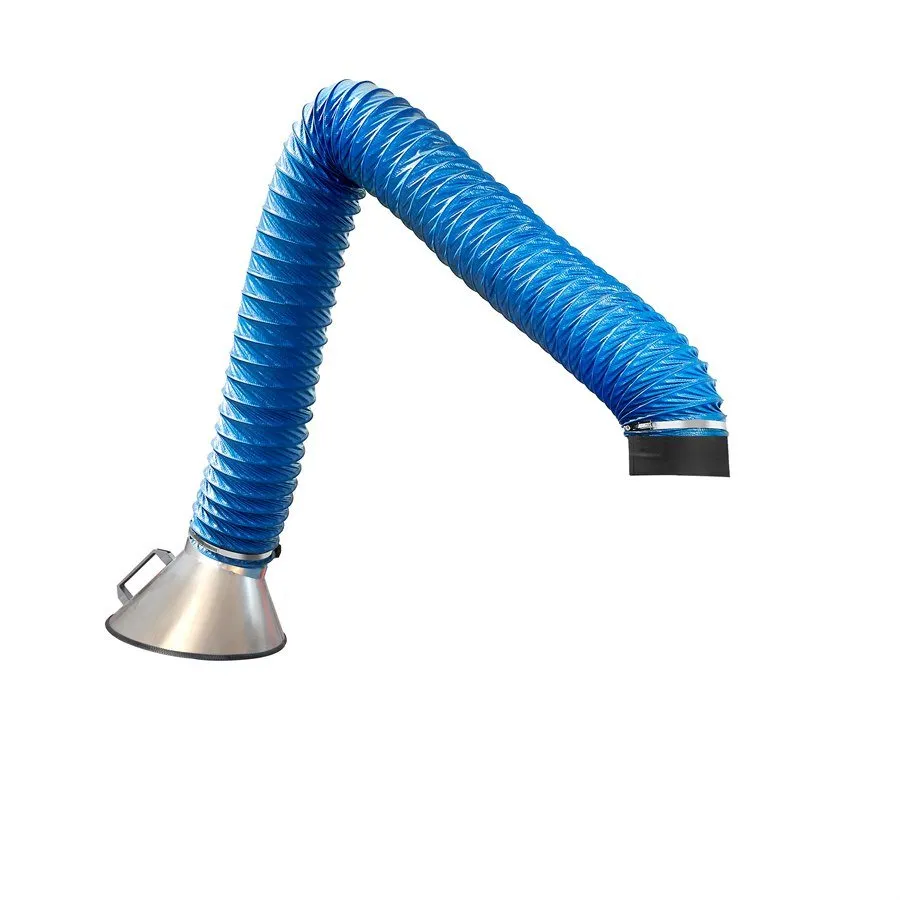
Extraction only works if the hood catches the fume before the shop’s air movement takes it away. In practice that means the hood has to sit within roughly one hood diameter of the arc, and the airflow at that distance has to be strong enough to overcome the cross-draught from doors, cranes and forklifts.
For a typical MIG bench with a 200 mm hood at 250 mm from the arc, we work on 1,000 – 1,500 m³/h per active station. A larger canopy hood with a longer distance needs considerably more, which is why moving the hood closer usually saves more money than adding filter area.
Then add the duty cycle
Two welders who weld for 20 minutes an hour do not load a filter like one welder who welds continuously. Duty cycle decides the dust load; dust load decides how often the cartridges have to be cleaned or replaced. For continuous production we specify the larger platform and a pulse-cleaning controller; for intermittent maintenance work a mobile unit is usually the better economic answer.
Do not forget the spark
Sparks and hot spatter reach the filter on the inlet side. A spark catcher is a small, cheap component that prevents the media from being burnt through in the first months of service — we fit one to every welding and grinding system we supply, and it can be retrofitted to an existing collector at the inlet.
What we need from you
To size a system accurately we ask for: the process and material, the number and type of extraction points, the distance from the arc to the hood, the shift pattern, and the available power supply. Send those five answers with your enquiry and the first quotation is usually the right one.